The Self-Healing Path
Many People, Many Paths
We each need to find our own path; however, we must be careful, as we tend to find exactly what we are looking for in life. If you’re looking for injustice or evil, you will see it everywhere. If you’re looking to start a fight, that’s easy. Likewise, look close enough, and you’ll also see life and love all around you, inside and out, and everywhere in between. There are a lot of good people working hard to make this world a better place!
If you’re looking to feel better, you will likely figure out how to eventually… but it is not easy.
As I personally started to make positive traction in my own life away from the pit of despair and began to feel stronger and less susceptible to wild fluctuations in my attitude resulting from chronic pain, it seemed logical for me to want to put together a path that anyone could follow. The desire to help others grew exceptionally strong when I encountered fellow U.S. veterans in a state of apathy, despair, and hopelessness because their sense of self as separate from the body had collapsed.
Soon, I realized there was no need to create yet another series of steps when so many other smart folks had already done so. Dozens of books on my self-healing shelf are often authored by doctors who have worked with chronic pain patients for as many as thirty years! Undoubtedly, these good doctors and Ph. D.s had already put together some excellent steps that are familiar to every path. No reason to reinvent the wheel!
Therefore, reviews and comparisons of self-healing books will be part of the fundamental content on The Body Is Mind. I will review and summarize the most potent books, the most influential authors, and the most effective programs available to everyone. I will help make the information accessible to you so that the prevailing wisdom is within easy reach.
How Your Mind Can Heal Your Body
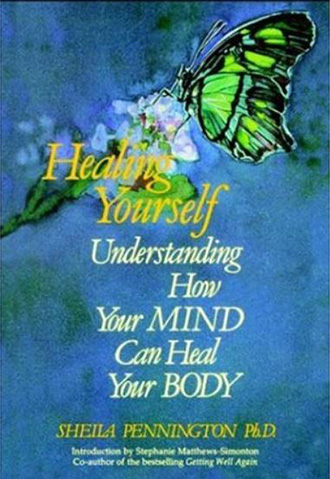
One of my favorite books is Healing Yourself: Understanding How Your MIND Can Heal Your BODY by Sheila Pennington, Ph.D.
“Inspired by successful self-healing, Sheila embarked on a study of six patients with a terminal diagnosis who lived at least three years longer than predicted.”
Then in 1983, she participated in a particularly enlightening 2-day symposium about “The Role of Belief In The Healing Process,” where she presented her findings to a gathering of 200 doctors and healing practitioners.
Five years later, in 1988, this life-saving information culminated in the publication of her book.
In her book, Sheila identifies seven critical steps common to every person who struggles with how to spend their life when they know their days are limited. Those who find meaning in their suffering can make remarkable changes in their lives and perspectives.
Although the idea that the body is mind was not prevalent back then, we highly recommend the book for anyone with an epic chronic struggle.
The seven stages of the healing path are illustrated below.
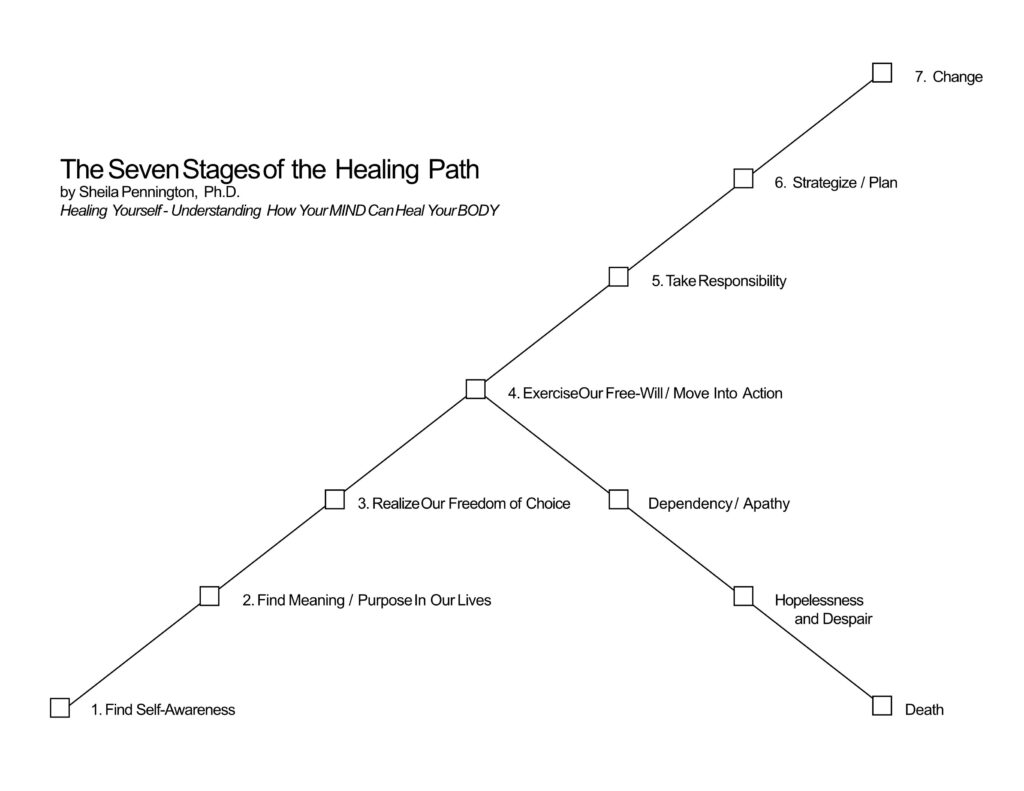
The seven-step path upwards from here to change starts with:
- Find Self-Awareness
- Find Meaning/Purpose In Our Lives
- Realize our Freedom of Choice
- Exercise Our Free-Will/Move Into Action
- Take Responsibility For Our Health
- Strategize and Plan Our Improvement
- Make the Changes In Our Lives We Need.
Step 4 is a fulcrum point; release of personal responsibility and lack of action leads downwards towards dependency, apathy, hopelessness, despair, and ultimately death. The seven-step process is then repeated, again and again.
If you’re not on the upward ladder, then finding self-awareness is your step-1 ticket.
Except you can’t get to [Step 1: Find Self Awareness] unless you first choose to exercise your FREE WILL in relation to your health! And busting your free will from the grip of apathy will inevitably require you to find self-compassion, gratitude, and self-forgiveness as part of your journey.
Finding Your Path Toward Wellness
Everyone who faces the challenges of living with chronic pain, PTSD, anxiety, and stress-related illness can easily relate to the same stages that people who meet a terminal diagnosis go through. Most other programs outlined by doctor-authors who have successfully treated people with chronic pain usually assume that you want to take your health into your own hands, and almost every one of them begins at the same step.
It seems unanimous that our attitude toward our health and our ability to imagine a better or worse future play a more significant role than most people might think. Consequently, if you follow a program that starts off with the assumption you’re ready to make a change in your life, it often wholly overlooks several other key ingredients vital to your success.
If you’re not quite feeling up to living and find yourself unable to change, and you suffer from depression or a lack of motivation, there are some things you’ll need to handle before you can expect ANY medicine or advice to have any effect on your wellness.
For those of us who are feeling like there’s no point in living this life, then there’s also no possibility for change and no chance we’ll take responsibility for our health no matter what the doctor tells us.
If we believe we are getting worse, then we will get worse. If we haven’t handled childhood trauma yet, we often find ourselves in unchangeable behavior patterns filled with guilt and addictions. If we walk around angry all the time, feeling like the victim of our pain or misfortune, then we’ll indeed have a rough time of it.
Changing our attitude can shift our entire perspective. Facing imminent death has a way of helping us prioritize. But do we really need to let it get that far before we decide to change?
Unfortunately, it may not be that easy to make such a decision.
Believe In Yourself
There are many reasons why healing cannot take place, and many reasons why, sometimes, it seems no amount of drug prescriptions can help us. But if we can’t imagine a better future for ourselves, if we don’t believe our condition can be better, and if we don’t have a reason for living, then self-healing from pain or misery will never manifest in our lives.
Self-healing begins when you believe it’s possible. The concept means different things to different people. For some, self-healing might mean a physical miracle. For others, self-healing may mean simply changing their thought patterns just enough to relieve their suffering, if not their pain.
Many of us just need to stop beating ourselves up so much!
This website is intended to help you find your path out of darkness and despair, even if you have a terminal diagnosis. Especially if your condition fluctuates wildly, our hope is you can find something here on this website worth trying in an attempt to improve the quality of life, either for you or someone you love.
One must believe in oneself to live at all!
More About Shiela’s Book
For those of you interested in picking up a copy of Shiela Pennington’s book, “Healing Yourself: Understanding How Your Mind Can Heal Your Body,” here’s a link to the book on Amazon (click the book icon below). Print editions are in limited supply and there’s not a Kindle version of the text yet.
This book is considered to be a “Hidden Gem” because it was ahead of its time when published originally in 1988. It has taken over 30 years to be incorporated into modern psychology and mind-body medicine as information of its kind. Even today, we still shy away from the roles free will and self-awareness play in our healing, and we still refer to the power of consciousness as the “placebo effect” in most scientific literature.
In this book, Sheila Pennington unveils the role of belief, meaning, purpose, self-awareness, and freedom of choice along with the power of a self-directed healing path. She did this research in the very early 1980’s while studying people who had outlived their terminal diagnosis by at least three years.
The first mention of her discoveries is found in a Canadian Medical Association Journal publication, Vol. 128, May 1, 1983, as listed under “The Role of Belief In Healing” on the National Health Institutes website, so check out that article for additional background info.